Blog · Technology
Scaling Voice AI Is Easy to Promise and Hard to Deliver: What Enterprises Should Look For?
Hamsa Team ·November 10, 2026
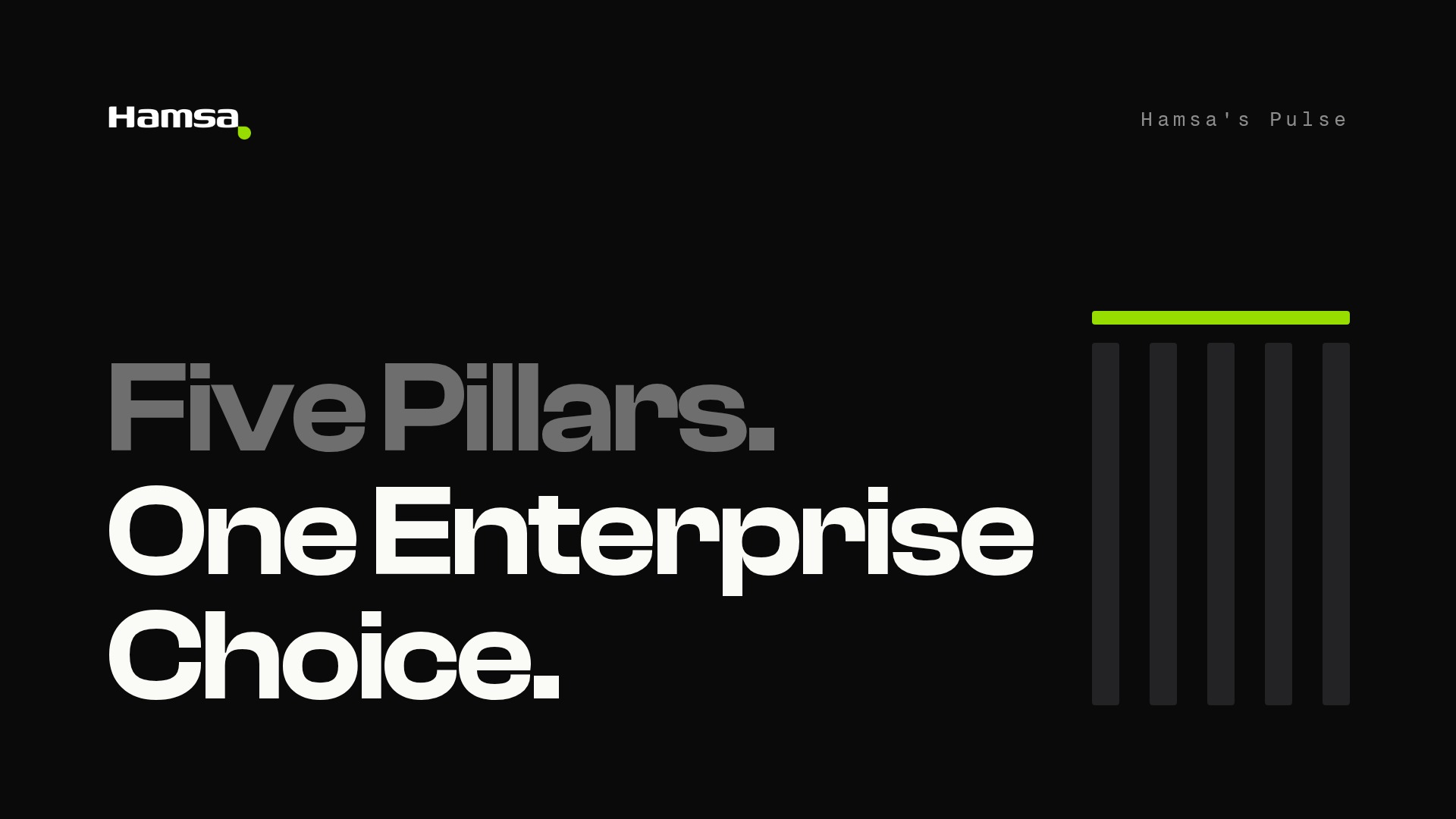
Most Voice AI pilots look impressive. You get a demo call, a clean transcript and an agent that answers in the right dialect. Everyone in the room nods. Then month six comes. The agent now has to handle ten times the call volume. It has to write back to the CRM and pass cases to the human team without losing context. Legal asks where the voice data is stored. Operations asks why one region's resolution rate dropped last week, and nobody can answer. The vendor's support team replies two days later. This is where most Voice AI projects stall. The models are usually fine. What breaks is everything around them. For decision makers, the question isn't "Does it work?" The real question is: "Will it still work, and will we still trust it, when it's running across our whole organization?" At Hamsa, we see long-term scalability as five things working together: 1. Workflows: Scaling the Process A voice agent that answers questions is a feature. A voice agent that completes the job is part of your operation. Real scalability means the agent fits the workflows your teams already run. It qualifies a lead and books the appointment. It screens a job candidate and sends the summary to HR. It takes a citizen request and sends it to the right department. It escalates to a human agent and passes along the full context. Hamsa's agents are already in production across call automation, HR operations, banking, insurance, media and government services. That's possible because each workflow is designed around the business process. We don't make teams reshape their process around the AI. 2. Integrations: Scaling Without Rebuilding No enterprise wants to rebuild its tech stack to adopt one technology. Voice AI has to plug into what you already run. Hamsa is built to connect with the systems enterprises use every day, including CRMs, help-desk and contact center platforms, and workflow automation tools. Flexible APIs cover anything custom. Every conversation can update a record, open a ticket or trigger the next step, so nobody has to re-enter data by hand. The result is that voice becomes a new layer on your existing systems, not a new silo to maintain. 3. Governance: Scaling With Control When AI talks to your customers, it speaks for your brand and handles your data. Governance can't be added later. It has to be part of the design from the start. That's why Hamsa offers three deployment models: SaaS, private cloud and fully on-premise. Some organizations need data to stay inside their own walls, and some face strict national data residency rules. Either way, the deployment fits the policy, and the policy doesn't have to bend to fit the deployment. Our partnership with OmniOps makes Hamsa's speech-to-text, text-to-speech and AI agents available on Bunyan, OmniOps' sovereign inference platform in Saudi Arabia. Enterprises there get Arabic voice AI that meets the Kingdom's sovereignty and compliance requirements from day one. Owning our full stack matters here too. Hamsa builds its own models, so we can answer the questions your compliance team will ask about where data goes, what trains on it, and who controls it. 4. Monitoring: Scaling With Visibility You can't scale what you can't see. As voice AI spreads across regions, dialects and use cases, leaders need a clear picture of what's happening: transcripts, sentiment, outcomes, and where conversations succeed or break down. Hamsa supports more than 14 Arabic dialects. Monitoring at that level of detail is how you make sure every customer gets the same quality of experience, whether they speak Gulf, Levantine or Egyptian Arabic. Visibility turns voice AI from a black box into a performance channel you can measure, report on and improve. 5. Support Across Teams: Scaling Together An enterprise deployment touches IT, operations, customer experience, compliance and leadership, and each of those teams needs something different. Hamsa works with all of them. Our solutions engineers design production-ready proofs of concept around your real use cases. Our team supports integration and rollout. We stay involved after go-live, because that's when scaling actually starts. Scaling Through an Ecosystem, Not Alone No single company scales enterprise AI by itself. Long-term scalability also depends on who stands behind the platform. Hamsa works alongside some of the most trusted global names in technology and enterprise delivery, including Sprinklr, AWS, Dell and PwC. Together they bring the infrastructure, customer experience platforms and enterprise reach that let Arabic voice AI move from pilot to organization-wide deployment. Regional partners like OmniOps, CGC, SBM and Wesal add the local depth enterprises in the region need, from sovereign infrastructure to on-the-ground implementation. For enterprise leaders, this means Hamsa doesn't arrive alone. It arrives with an ecosystem already built to support you at scale. Why This Made Hamsa the Enterprise's Choice? Organizations like PwC, Dell, and Abu Dhabi Government didn't choose Hamsa because of one great demo. They chose it because the five pillars held up together: Workflows: that complete real business processes Integrations: that fit their existing stack Governance: that meets their data and compliance requirements, including on-premise and sovereign deployments Monitoring: that shows them how every conversation performs Support: that covers every team the deployment touches When all five are in place, the decision gets easier, because the usual reasons to hesitate have already been answered. This Is Just the Beginning! Scalability is one reason enterprises choose Hamsa, and there are many more. tryhamsa.com
Hear it for yourself.
Try Hamsa’s models live on the homepage demo. No signup needed.