Blog · Technology
"Supports Arabic" Is the Most Misleading Claim in Voice AI
Hamsa Team·October 4, 2026
Picture a customer in Kuwait calling their bank. They say, the way they'd say it to anyone: "أبي أغيّر موعدي." (I want to change my appointment.)
The voice agent pauses. Then it answers in flawless, formal Modern Standard Arabic, the register of a news anchor reading the evening bulletin.
The customer doesn't feel helped. They feel like they're talking to a machine, and they ask for a human.
The vendor's slide said "Arabic supported." Technically, it was true. This is the gap almost nobody in voice AI talks about.
Arabic isn't one language on the phone
Modern Standard Arabic (MSA) is the language of news, contracts, and speeches. It's essential, but it's nobody's mother tongue. Real customer calls happen in dialect, and the dialects differ a lot:
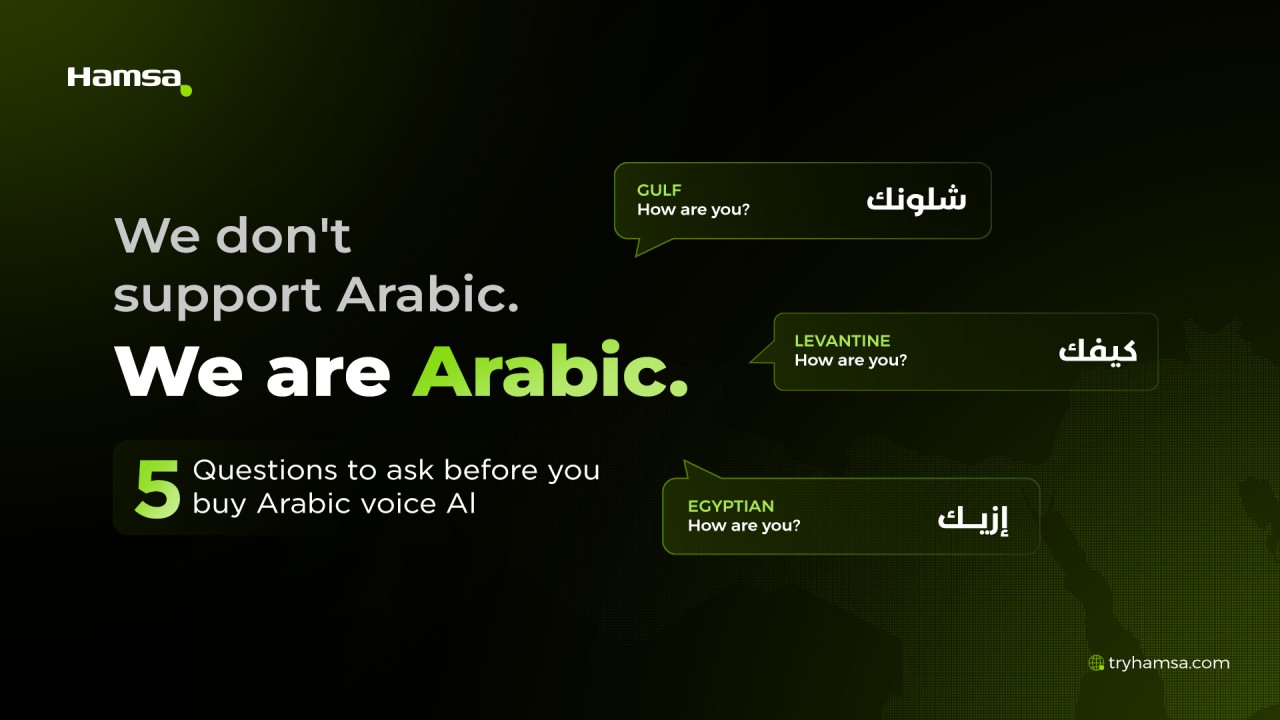
• How are you? شلونك (Gulf) · كيفك (Levantine) · إزيك (Egyptian)
• I want: أبي / أبغى (Gulf) · بدّي (Levantine) · عايز (Egyptian)
• Now: الحين (Gulf) · هلأ (Levantine) · دلوقتي (Egyptian)
A system trained mostly on MSA can look impressive in a demo, where someone reads a clean script into a good microphone. Then it meets a real caller on a noisy line, and the accuracy falls apart.
"Supports Arabic" tells you almost nothing. The useful question is: which Arabic, on which calls, at what accuracy?
What real Arabic calls throw at a voice agent
Dialect is only the start. Production calls in the region also include:
• Code-switching: Callers move between Arabic and English mid-sentence, especially for product names, amounts, and technical terms.
• Backchannels: The small sounds people make to show they're listening ("aha", "mm-hmm", "yalla") aren't interruptions. An agent that treats them as interruptions, or misses them, feels robotic.
• Grammatical gender: Arabic verbs and adjectives change depending on whether the agent is speaking to a man or a woman. Get it wrong and the call sounds broken, or worse, disrespectful.
• Real audio: That means traffic, overlapping speech, and speakerphone, not studio recordings.
None of these shows up in a checkbox, and all of them decide whether a customer stays on the line.
What about the 5-question test? Before you sign with any Arabic voice AI vendor, ask:
1. Which dialects, exactly, and how were they tested? "Gulf Arabic" isn't one thing, and neither is "Levantine." Ask for results on real call audio, not read speech.
2. What happens when the caller switches to English mid-sentence? Ask them to demo it live, with your own examples.
3. How does it handle the way people actually talk? Test interruptions, backchannels, hesitations, and noisy lines. Ask to hear unedited call recordings.
4. Does it get grammatical gender right? Have a man and a woman each call the same agent. Listen closely.
5. Who owns the stack, and who fixes it when it breaks? Speech recognition, language understanding, and voice generation all affect the caller's experience. If the vendor stitches together third-party components, ask how quickly they can diagnose and fix an error in a live deployment.
A vendor who answers all five with specifics has probably done the work. One who answers with "we support Arabic" hasn't.
How we approach it at Hamsa: We build Arabic-first, not Arabic-added. Our voice agents are designed for dialect from the start, and we own the full voice stack, so when something in production sounds wrong, we can trace it to the source and fix it.
That's what has taken us beyond pilots into production with organizations like PwC, SBM, DGE, Jawwal, and more.
The bottom line: Arabic voice AI is moving from demos to real customer conversations, and the market will start rewarding accuracy where it counts: in the dialect your customers actually speak. So the next time a vendor says "we support Arabic," don't nod. Ask the five questions above!
Want to see how an Arabic-first voice agent handles your dialect, your accents, and your call flows? Book a live demo with Hamsa.
Hear it for yourself.
Try Hamsa’s models live on the homepage demo. No signup needed.